Government Challenges EQUSaT to Lead in Competence-Based Education,...
October 23, 2026

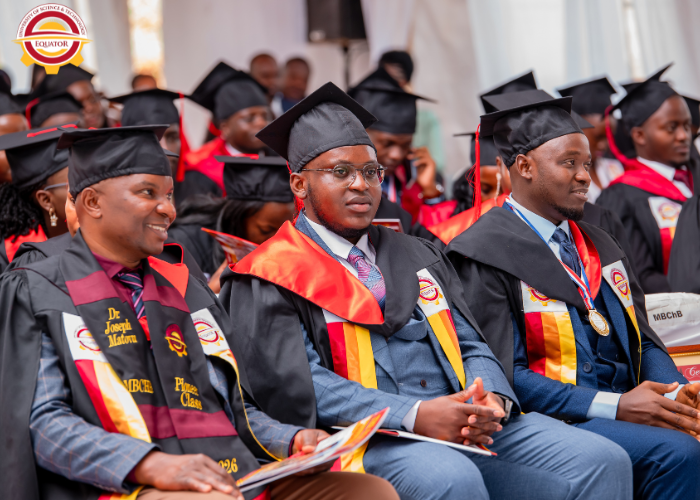
At its historic first graduation ceremony, Equator University of Science and Technology received a strong message from the Government of Uganda: build on the milestone, embrace educational transformation and produce graduates whose knowledge and competencies translate into meaningful societal impact.
The Government of Uganda has commended Equator University of Science and Technology (EQUSaT) for its steady institutional growth, contribution to higher education and investment in priority areas of national development, while challenging the young institution to position itself as a leading centre for science, technology, health sciences and innovation.
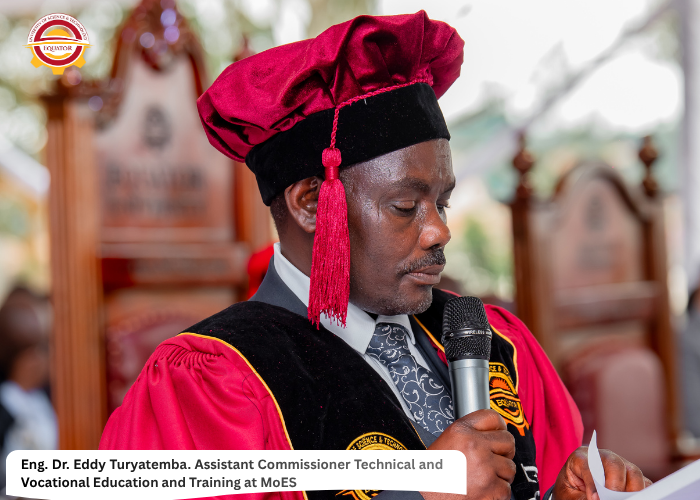
The message was delivered by Eng. Dr. Eddy Turyatemba, Assistant Commissioner for Technical and Vocational Education and Training (TVET) at the Ministry of Education and Sports, who represented the Minister of State for Higher Education and Acting Minister of Education and Sports, Hon. Dr. Chrysostom Muyingo, as Chief Guest at EQUSaT's First-Ever Graduation Ceremony held on 23 October 2026 in Masaka, Uganda.
Addressing university leadership, government representatives, international delegates, academic partners, parents and graduands, Eng. Dr. Turyatemba described the inaugural graduation as a defining institutional achievement, representing years of planning, investment, teaching, learning and perseverance.
He observed that a university's first graduation signifies more than the completion of academic programmes; it demonstrates that an institution has moved beyond its founding vision and begun contributing to the development of human resources required to transform society.
In his address, the Chief Guest recognised EQUSaT's contribution to expanding access to higher education in Uganda, particularly through private-sector investment and collaboration with public institutions.
He noted that the University's growth demonstrates the importance of complementary roles played by public and private higher education providers in responding to the country's evolving human resource needs.
He also acknowledged the University's investment in science, technology, health sciences and innovation, describing these disciplines as critical to Uganda's Vision 2040 and broader development aspirations.
The Government's recognition extended to EQUSaT's institutional growth and its engagement with the National Council for Higher Education, through which the University had received positive assessment feedback regarding compliance and stable growth.
For EQUSaT, this recognition reinforces the importance of maintaining academic quality, institutional accountability and programmes that respond to both national and international development priorities.
A significant part of the address focused on the role of partnerships in strengthening higher education and improving service delivery.
The Chief Guest highlighted the collaboration between EQUSaT and Masaka Regional Referral Hospital, particularly the jointly operated dental clinic, as an example of how institutional partnerships can improve access to healthcare while creating opportunities for clinical training and practical student exposure.
He also recognised EQUSaT's hosting of the 2025 national World Oral Health Day celebrations, organised under the Ministry of Health, as an illustration of the University's contribution to public health awareness and community engagement.
These initiatives demonstrate an important principle of modern higher education: universities must extend their influence beyond lecture rooms and academic assessments to address real challenges within the communities they serve.
Looking ahead, Eng. Dr. Turyatemba encouraged EQUSaT to explore opportunities for specialised postgraduate training in dentistry, particularly in areas such as oral and maxillofacial surgery, periodontology and orthodontics. He observed that Uganda and the wider region continue to face shortages of specialists in these fields.
He emphasised that EQUSaT's existing dental infrastructure and clinical partnerships provide a foundation upon which such programmes could be considered, subject to the necessary regulatory approvals, qualified academic personnel and clinical training standards.
One of the most significant messages from the Government centred on the ongoing transformation of Uganda's education system towards Competence-Based Education and Training (CBET).
With the planned transition to competence-based curricula across higher education institutions effective in the 2027/2028 academic year, the Chief Guest urged universities to begin preparing for an educational model that places greater emphasis on practical abilities, professional competencies, innovation and workplace readiness.
He challenged EQUSaT to embrace these reforms early, arguing that education must move beyond the transmission of theoretical knowledge to developing graduates capable of demonstrating what they know through practical application, critical thinking, creativity and problem-solving.
He further emphasised that successful curriculum transformation requires investment in modern infrastructure, laboratories, training facilities, staff development and stronger partnerships between universities, industry and communities.
His call extended to government institutions, private enterprises, professional associations and development organisations to strengthen collaboration with universities through internships, clinical placements, apprenticeships, research partnerships and mentorship opportunities.
For EQUSaT, this direction aligns with its commitment to integrating academic learning with practical experience, ensuring that graduates are equipped not only with qualifications but also with the competencies needed to contribute effectively in their respective professions.
Recognising that institutional growth requires continuous commitment, the Chief Guest urged EQUSaT's Board of Trustees, University Council and Management to sustain investment in academic quality, research, digital technologies, modern laboratories, clinical training facilities, student welfare and staff development.
He stressed that a university's reputation should not be measured merely by its enrolment figures or physical infrastructure, but by the quality of its graduates and the positive difference they make in society.
This message presents an important responsibility for EQUSaT as it enters its next phase of institutional development: to consolidate its achievements, strengthen its academic systems and cultivate a research culture responsive to Uganda's development challenges and the wider global agenda.
He also acknowledged the vision and investment of the University's founders and promoters, recognising their contribution to human capital development, science, technology and the country's future prosperity.
Perhaps the most compelling part of the Chief Guest's address was his message to the pioneering graduates.
Congratulating them on their achievement, he reminded the graduands that their qualifications carry responsibilities that extend beyond personal advancement.
He encouraged them to approach their professional journeys with humility, integrity, discipline and a commitment to serving humanity, emphasising that the true measure of education lies not simply in the titles individuals acquire but in the difference they make in the lives of others.
To the medical and dental graduates, he underscored the responsibility of preserving human life, relieving suffering and protecting human dignity. He urged them to uphold professional ethics, respect patient confidentiality, demonstrate compassion and commit themselves to lifelong learning.
For graduates in Information Technology and Computer Science, he highlighted the opportunities presented by digital transformation, encouraging them to develop innovative solutions to real-world challenges, create enterprises and contribute to employment generation.
He similarly challenged Business Administration graduates to become ethical business leaders, responsible entrepreneurs and strategic thinkers capable of building sustainable organisations and creating opportunities for others.
His overarching message was clear: academic qualifications should be the beginning of continuous learning, innovation and service, rather than the conclusion of one's educational journey.
The Chief Guest's address offered both recognition of EQUSaT's progress and a forward-looking challenge.
As the University celebrates its first graduating class, it does so with a renewed responsibility to strengthen its contribution to education, healthcare, research, innovation and sustainable development.
The priorities highlighted in the address resonate with the United Nations Sustainable Development Goals, particularly SDG 4 (Quality Education), SDG 3 (Good Health and Well-being), SDG 8 (Decent Work and Economic Growth), SDG 9 (Industry, Innovation and Infrastructure) and SDG 17 (Partnerships for the Goals).
These connections reflect the broader role of universities as drivers of knowledge, human development and solutions to societal challenges.
For EQUSaT, the first graduation is therefore not simply a celebration of academic completion. It is an affirmation of the University's responsibility to produce professionals who can contribute locally, nationally, regionally and globally.
As Eng. Dr. Turyatemba conveyed on behalf of the Government, the expectation is that EQUSaT will build on this foundation, embrace educational reforms, strengthen partnerships and continue contributing meaningfully to Uganda's national development agenda.
The pioneering graduates have taken their first step into the world of professional responsibility. For EQUSaT, a larger journey begins: transforming knowledge into competence, innovation into solutions, and education into lasting impact.
EQUSaT — ENABLING HUMAN CAPACITY.