Antimicrobial Resistance: Why Protecting the Effectiveness of Medic...
November 18, 2026

Prof. Mouhamad Mpezamihigo told regional education leaders that competency-based education and training is the paradigm shift needed to transform human capacity development.
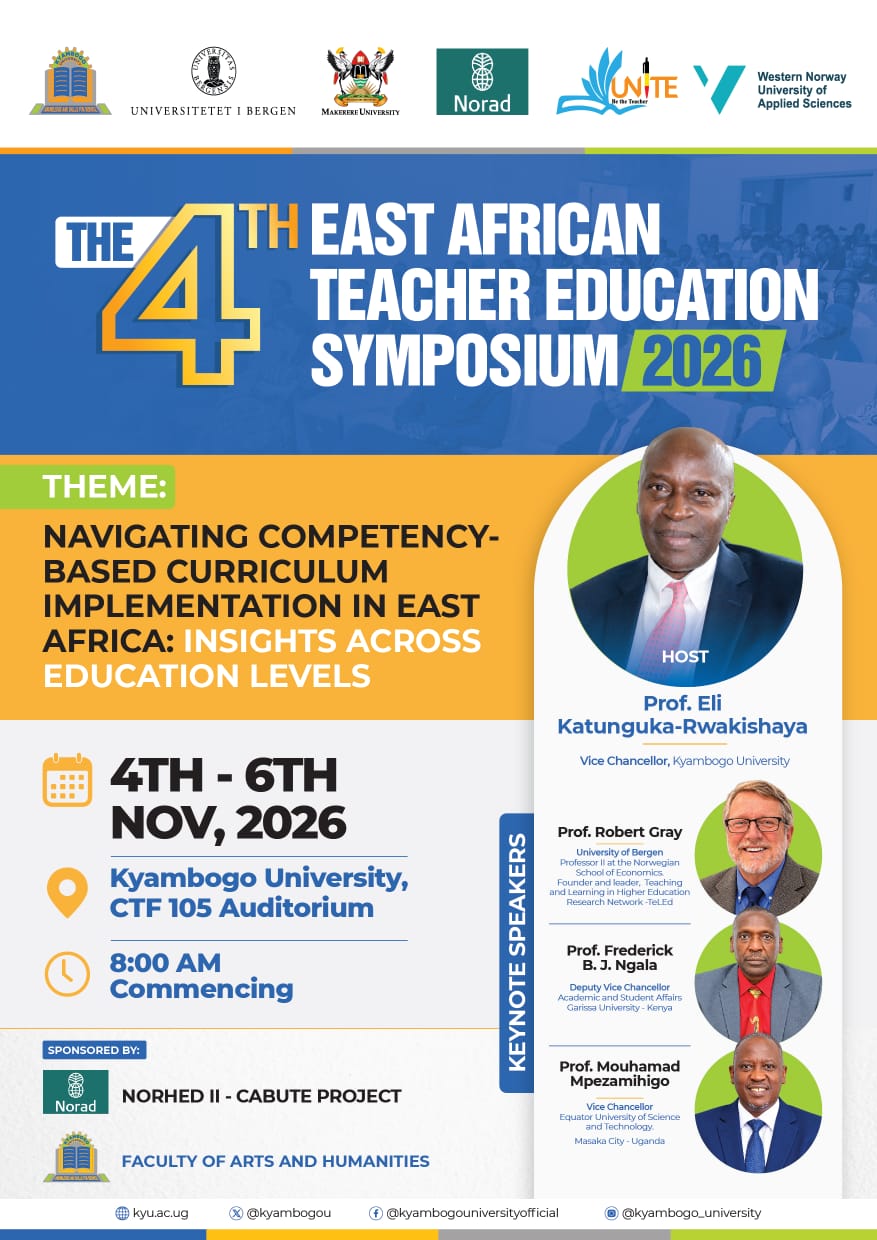
The Vice Chancellor of Equator University of Science and Technology (EQUSAT), Prof. Mouhamad Mpezamihigo, delivered a keynote address at the 4th East African Teacher Education Symposium (EATES), hosted by Kyambogo University from 4th to 6th November 2026. He spoke on 6th November, the final day of the symposium.
The three-day symposium was organised by Kyambogo University's Faculty of Arts and Humanities and held at the Central Teaching Facility, Auditorium 105. It brought together researchers, teacher educators and policymakers from Uganda, Burundi, Kenya, Rwanda, South Sudan, the Democratic Republic of the Congo, Somalia and Tanzania. The theme was "Navigating Competency-Based Curriculum Implementation in East Africa: Insights Across Education Levels."
Opening by the Guest of Honour
The symposium was officially opened by the Commissioner for Higher Education, Mr. Timothy Musoke Ssejjoba, who underlined the critical role of teachers in turning curriculum intentions into meaningful learning outcomes. He noted that Uganda's Vision 2040 and the Tenfold Economic Growth Strategy require a skilled, innovative, ethical and adaptable workforce.
Mr. Ssejjoba stressed that competence-based education must not compromise foundational knowledge. It should combine sound knowledge, practical skills, appropriate attitudes and values, and the ability to apply them in real-life situations. He called for more investment in teacher preparation, continuous professional development, mentorship, inclusive education and practical assessment, and for stronger collaboration among universities, teacher education institutions and schools. "If we want competent graduates, we must prepare and support competent teachers," he said.
The keynote: a paradigm shift in human capacity development
Titled "Competency-Based Education and Training: The Paradigm Shift Essential to Trigger Transformation in Human Capacity Development," Prof. Mpezamihigo's address placed competency-based education and training (CBET) within a wider picture. That picture included the purpose of education, the pathways learners follow, demographic realities, the gap between the number of graduates and available jobs, government pressures, employer expectations, disruptive technologies and the policy environment.
He observed that education institutions have traditionally delivered learning in largely staff-centred ways. Vocational institutes and polytechnics, by contrast, expose learners to more practical, skills-focused training. In programmes such as health sciences and teacher training, practice often comes late in the programme through supervised observation. Without aligning that practice to learning outcomes and competencies set before a programme begins, those competencies can remain unachieved.
CBET, he argued, calls for the deliberate, intentional and measurable cultivation of essential skills: communication, critical thinking, problem solving, innovativeness and adaptability to work and life situations. He asked whether the different levels of education can communicate under CBET, and drew on Uganda's qualification frameworks, the Uganda Higher Education Qualifications Framework (UHEQF) and the Uganda TVET Qualifications Framework (UTQF), to illustrate the pathways.
Prof. Mouhamad Mpezamihigo outlined the foundations of a robust CBET system:
He also identified the practical constraints on aligning to and implementing CBET: time, redesign of existing infrastructure, re-tooling of human resources, transitional management, existing and already-graduated cohorts, non-science programmes, and government support and policy.
Way forward
The keynote closed with a call to action. He noted that there are many players in CBET across all levels of education, that integrated CBET across all levels will enhance adoption, and that CBET should not "kill" knowledge creation and production. He urged continuous benchmarking with other countries to adopt best practices, the application of digital technologies in implementation, and a reminder that institutions train graduates not only for local consumption but for the world beyond borders.
About the symposium
The East African Teacher Education Symposium is an annual international forum promoting research, innovation and collaboration in teacher education in Uganda and across the region. Other keynote speakers at the 2026 edition were Prof. Robert Gray of the University of Bergen, Norway, and Prof. Frederick B. J. Ngala of Garissa University, Kenya. EQUSAT thanks Kyambogo University, led by Vice Chancellor Prof. Eli Katunguka-Rwakishaya, together with the organisers, partners, sponsors, speakers and participants.
Source for event details: Kyambogo University
November 18, 2026
November 18, 2026
November 17, 2026